
Anthropic just fixed the one thing keeping AI out of insurance

The benchmarks are the least interesting part
Anthropic released Claude Fable 5.1 in September 2026. The coverage has focused on benchmarks, and the benchmarks are strong. If you run a brokerage or an advice firm, the benchmarks are also the least interesting part of the release.
The part that matters is data handling. I spent years in insurance building client-facing digital products, and every one of them was governed by data privacy policies before a line of code was written. I know the exact sentence that ends AI conversations in this industry: we cannot send client data to a model vendor. This is the first release where that sentence stops being true, and the detail deserves a careful walk-through.
The question every brokerage asks
Every AI conversation with a broker or an underwriting agency reaches the same point within twenty minutes. Where does our data go, who holds it, and for how long? Client files in this industry contain health disclosures, financial positions, and claims histories. The people responsible for those files ask the right question.
Until now the honest answer was uncomfortable. Most AI vendors retained prompts and outputs on their own infrastructure, for some period, under their own policies. A compliance officer hears that and closes the door, correctly. So firms bought the lowest-risk thing available instead, and the workflows that actually consume the week never changed. The frontier models, the ones capable of real multi-step work, stayed off the table because the data terms could not survive a compliance review.
What the Australian rules actually require
I am not a lawyer and this is not legal advice. Confirm anything here with your compliance function. But the shape of the obligations is worth stating plainly, because it explains why the door was closed.
Under the Privacy Act 1988 and APP 8, a firm that discloses personal information to an overseas recipient generally remains accountable for what happens to it. Sending client data offshore to a model vendor does not transfer the risk. You keep it.
APP 11 requires reasonable steps to protect personal information from misuse, loss, and unauthorised access, and to destroy or de-identify it when it is no longer needed. A vendor holding indefinite copies of your prompts sits awkwardly against that obligation.
The Notifiable Data Breaches scheme adds the consequence. An eligible breach means mandatory notification to the OAIC and to affected individuals. A vendor's retained copy of your client data is a copy you would have to account for.
APRA's CPS 234 binds APRA-regulated entities such as insurers, superannuation funds, and banks. It does not bind brokerages directly. It does cover information assets managed by third parties, and that is how its requirements reach brokers, underwriting agencies, and advisers, through the contracts you sign with the insurers you distribute for.
Four rules, one practical effect. If you cannot say where the data goes, you cannot proceed.
What zero data retention actually means
Two changes, one available now and one arriving in phases.
Now: eligible customers can use Fable 5.1 with zero data retention. Zero data retention means the provider processes your request and keeps nothing afterwards, so no copy of your client data sits on their systems. That is the sentence to take to your compliance officer. Note the word eligible. It is not automatic for every account. Confirming your firm's eligibility is a real task, and it belongs at the top of your list.
Rolling out to enterprise customers from later in 2026: a system Anthropic calls Enterprise Frontier Safeguards, which stores data in cloud infrastructure controlled entirely by the customer rather than by Anthropic. Read that against APP 8 and your CPS 234 flow-down clauses. Customer-controlled infrastructure is the architecture those obligations always pointed toward. The model is generally available on the Claude API, AWS, Google Cloud, and Microsoft Azure, which matters if your insurer partners have already approved one of those clouds.
Here is why this is bigger than a policy update. Regulated firms were not avoiding AI because the technology was weak. They were locked out of the strongest models by data terms, so the industry's AI experience has mostly been the watered-down, licence-per-seat version. Zero data retention puts frontier capability inside reach of a compliance framework for the first time. The question changes from whether you can use serious AI to which workflow earns it first. We covered how agents plug into the tools a firm already runs in connecting your business apps to AI agents.
Costs down by up to 45%
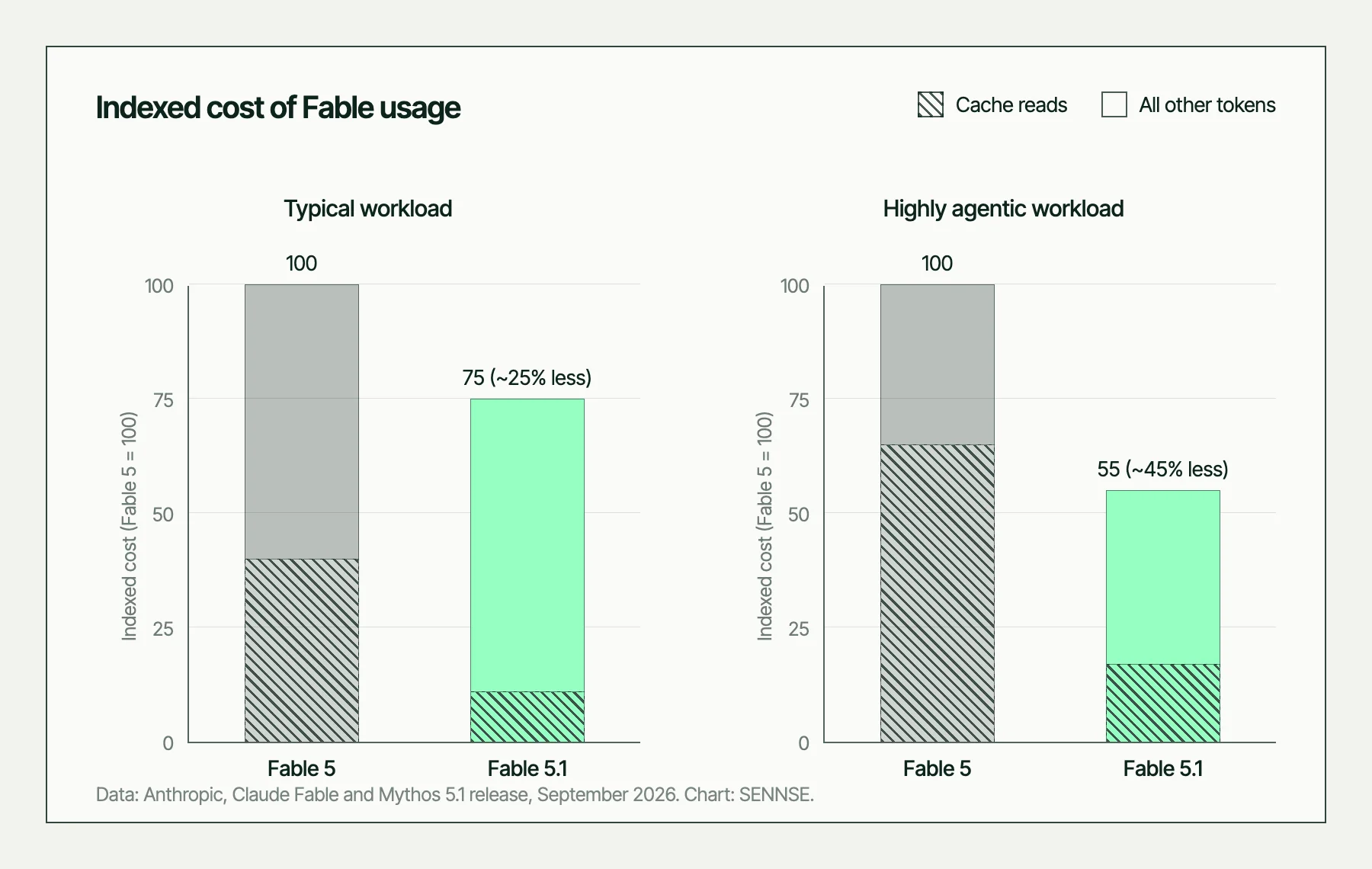
Fable 5.1 runs about 25% cheaper than Fable 5 for typical workloads, and up to about 45% cheaper for highly agentic workloads, because cache reads, where the model re-reads context it has already processed, now cost 75% less at $0.25 per million tokens. Base pricing is unchanged at $10 per million input tokens and $50 per million output tokens. Agentic work re-reads its context constantly, and that is the kind of multi-step work a firm actually wants automated, so the 45% figure is the one that matters.
Capability up on exactly the work a firm runs
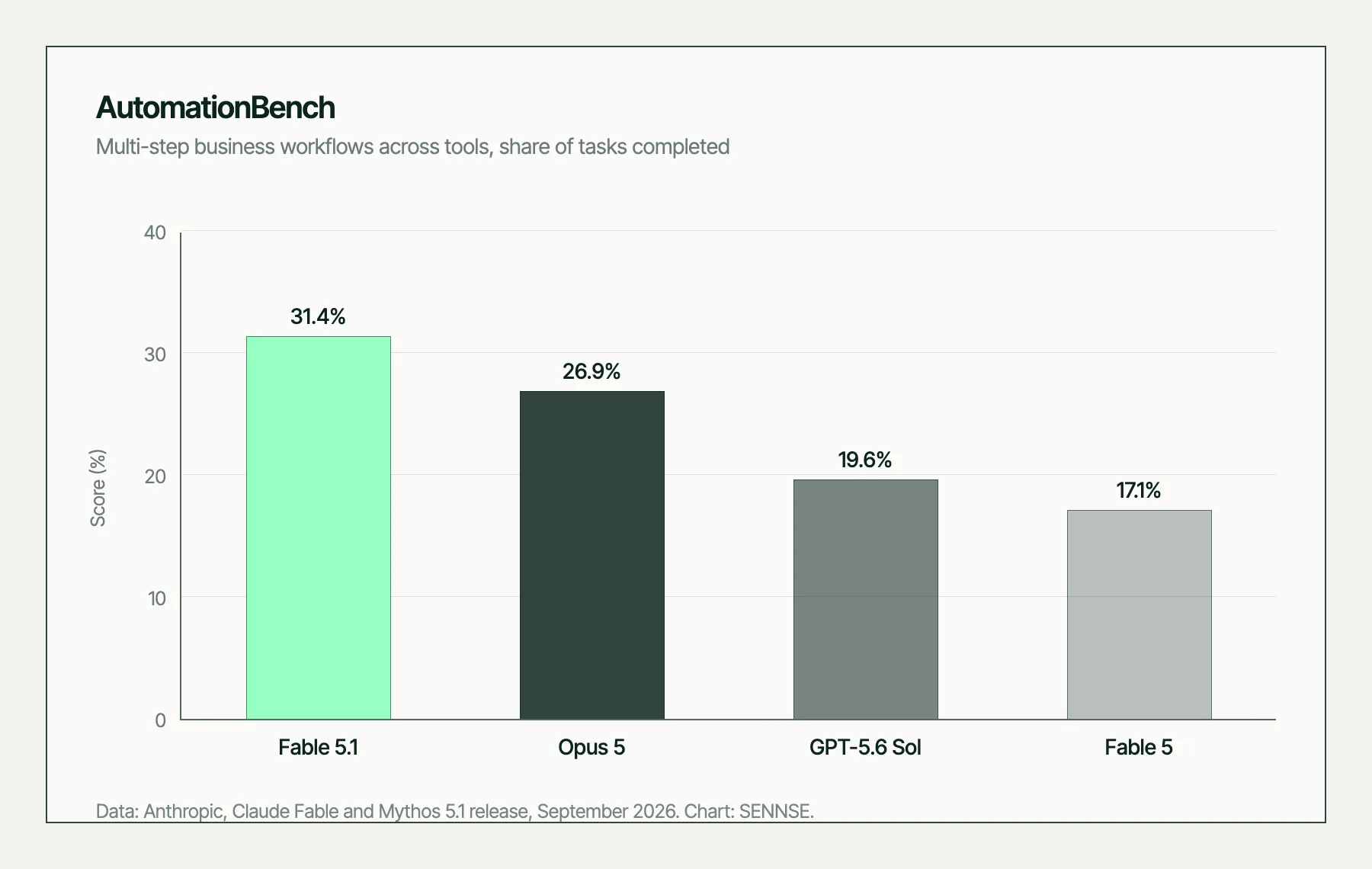
On AutomationBench, the benchmark for multi-step business workflows across tools, Fable 5.1 scored 31.4% against 17.1% for Fable 5. Nearly double in one release, and ahead of Claude Opus 5 at 26.9% and GPT-5.6 Sol at 19.6%. On GDPval-AA v2, a benchmark for knowledge work, it scored 1853 against Fable 5's 1723. Computer use rose from 72.9% to 77.9% on OSWorld 2.0.
The partner reports in the release read like a brokerage's task list. Browserbase, which builds infrastructure for browser agents, reported Fable 5.1 completing 82% of tasks on its hardest browser-agent benchmark, against 57% for Fable 5, on tasks of roughly ten minutes each. Working inside web portals is most of what insurance admin is. Crosby, a legal services firm, reported its RedlineBench contract-review benchmark improving from 47.9 to 57.0, with first-turn quality doubling. That is policy-wording territory. And Ramp, a finance platform, described an unattended 38-hour run where the system kept its own records, corrected an earlier result, and queued follow-up experiments overnight. Long-running work that survives without a person watching is what a claims follow-up queue needs.
One more number for the compliance-minded. Anthropic reports its safety filters now produce 60% fewer false positives than before. The guardrails did not get looser. They got more precise, which means fewer legitimate business requests blocked for no reason.
Put the numbers together. The work that failed often enough to be uneconomic a year ago now succeeds at nearly twice the rate, at close to half the cost. If AI automation lost the ROI argument at your firm in 2025, the maths deserves a rerun.
Where to start
Baseline the processes in your business that a model of this grade could carry. Measure what each one costs you today in hours before anyone mentions a tool. If you want a method for it, our AI opportunity audit baselines where the hours go and ranks the options by payback.
Speak to your compliance team about what data retention policy makes sense for your firm. Zero retention now exists as an option for eligible customers, so the conversation has a concrete position to work toward, and your compliance file gets it in writing.
Book a call with SENNSE to get started now. Every build in our case studies started with an agreed number, and yours would too. Get ahead of the competition and start harnessing Fable 5.1 properly.
The reason a brokerage said no to AI was data. That reason expired this month.
Sources
Anthropic: Claude Fable and Mythos 5.1 release.
Keep Reading
Connecting Your Business Apps to AI Agents · A plain-English guide to connecting the software your small business already runs on (email, calendar, accounting, CRM) to an AI agent, and what it pays back..
AI Agents for Marketing · AI agents are replacing manual marketing work for service businesses.
Let's Get Started
Book a free discovery call. We'll map where AI pays off in your business and what to do first.