
AI Agents for Marketing
The marketing team you didn't hire is already working
Most service businesses we speak with are still running marketing the way they ran it in 2020. A part-time marketer (or the founder, at 9pm). A CRM nobody updates. A website that captures leads and drops them into an inbox where they go to die.
Meanwhile, the businesses pulling ahead are quietly running AI agents that work 24/7. They qualify enquiries the moment they land, personalise outreach at scale, write and test ad copy, and route hot leads to the right person before a human has even seen the form submission.
This isn't ChatGPT with extra steps. AI agents are a different category of tool, and they're changing what's possible for businesses without a $20K/month marketing budget.
What an AI agent actually is
An AI agent is software that can take a goal, decide what steps to take, use tools (your CRM, your email platform, your calendar, your website) and complete tasks autonomously. Built on models like Claude, agents don't just answer questions. They do work.
For marketing, that work falls into several categories:
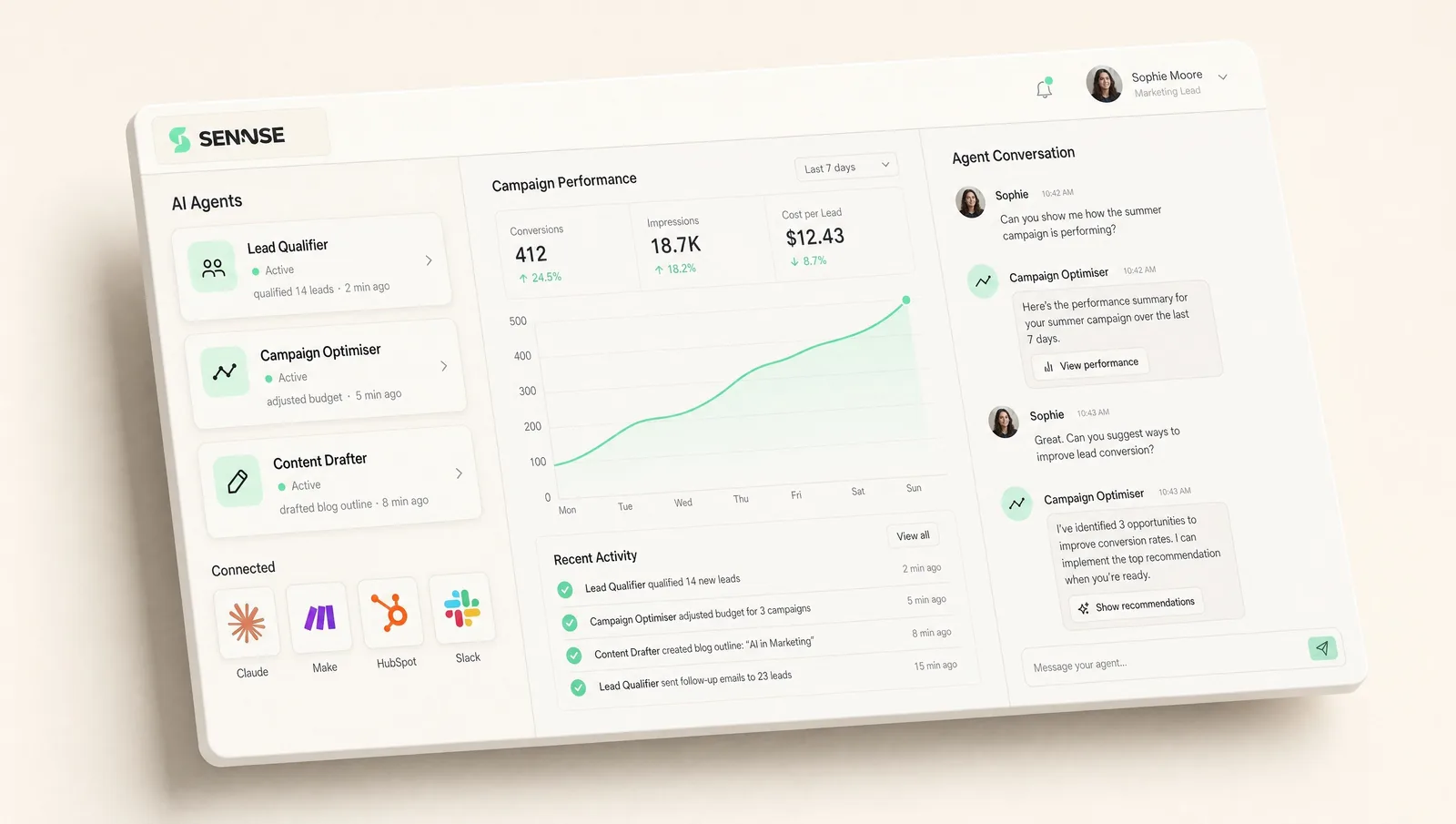
1. Lead qualification and routing. An agent reviews every inbound enquiry (form submission, email, chat), scores it against your ideal client profile, enriches it with public data, and routes hot leads straight to the right person with a pre-written response ready to send. What used to take 4 hours of admin per week happens in 30 seconds, per lead.
2. Outbound personalisation at scale. Instead of generic cold email blasts, an agent researches each prospect (their site, recent news, LinkedIn activity), drafts a genuinely personalised first message, and queues it for review. You go from 20 personalised messages a week to 200 without losing the personalisation.
3. Content production. Agents draft content targeting specific search terms, generate ad copy variations, write social posts from your existing case studies, and update meta descriptions across hundreds of pages. The human still reviews and signs off. The grind work is gone.
4. Campaign optimisation. Agents monitor your Google Ads and Meta campaigns continuously, pause underperforming keywords, reallocate budget and flag anomalies. They do at 2am what an agency analyst does on Wednesday afternoon.
Where it goes wrong
Three failure modes we see repeatedly:
Bolt-on AI. A clinic adds a chatbot to their site, doesn't connect it to the CRM, and now has a fourth disconnected tool. Agents only pay back when they're connected to the systems running the business.
No human handoff. An agent that tries to close the sale itself loses trust fast. Agents qualify, draft and route. Humans close. Don't skip that line.
Letting the model run blind. Agents need guardrails. A well-built deployment has clear escalation rules, logged outputs, and a human reviewing the first batch of conversations before it goes fully autonomous.
The window is closing
Two years ago, deploying an AI agent meant hiring a developer for three months. Today, with MCPs and orchestration platforms, a properly scoped agent goes live in 2 to 4 weeks. The businesses building this infrastructure now will spend the next 18 months compounding the advantage.
The competitors still hand-keying CRM updates and copy-pasting follow-up emails won't catch up. They'll just keep losing leads they never knew they had.
If your marketing still depends on someone remembering to follow up, that's the gap. AI agents close it.