
The AI Playbook for Service Businesses
The two-layer model
Every service business has two layers of operations.
The visible layer is what your clients experience: your website, your brand, the marketing that brings them to you, the proposal you send, the way you communicate during the engagement.
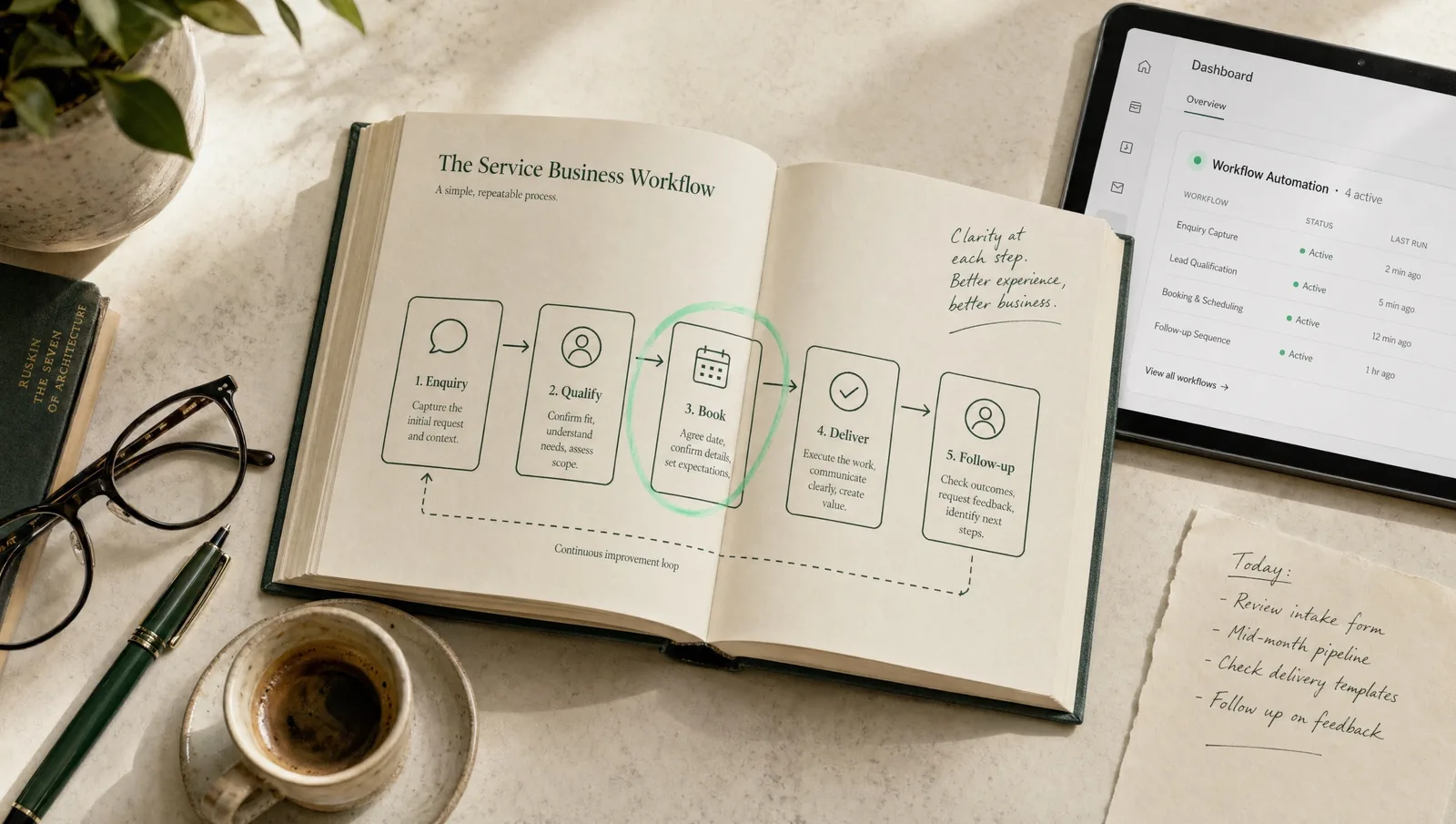
The invisible layer is what your team experiences: the intake form that captures the lead, the CRM that tracks them, the follow-up sequence that books them, the quoting workflow that closes them, the recall system that brings them back.
Most service businesses spend 90% of their AI thinking on the visible layer: chatbots, content generators, AI-written emails. This is the wrong layer.
The visible layer is where craft matters most. AI matters least there. A patient choosing a physiotherapist doesn't want to talk to a chatbot. A solicitor's prospective client doesn't want to read AI-generated blog posts. The visible layer is where your judgment, voice, craft create competitive advantage. AI dilutes it.
The invisible layer is where AI creates compound returns. Every lead that doesn't get followed up within five minutes is a lead lost. Every quote that takes three days to produce is a deal won by a faster competitor. Every patient who isn't recalled at the right interval is recurring revenue evaporating.
The right AI strategy for a service business starts in the invisible layer. It rarely leaves it.
Where AI actually pays for itself
Here's where we deploy AI in our clients' businesses, in order of commercial impact.
Lead qualification and routing. When an enquiry hits your website, an AI layer can read the message, classify it by urgency and fit, enrich it with public data about the prospect, route it to the right person with context already attached. The difference between a five-minute response and a five-hour response is roughly a 4x conversion rate.
Intake and onboarding. A new client takes 90 minutes of admin time to onboard properly: collecting information, sending agreements, scheduling kickoff, setting up file shares. We build intake flows that handle this in under five minutes of human time. AI generates the personalised welcome plus onboarding documents.
Follow-up sequences. This is the highest-ROI use of AI we've seen. Most service businesses lose 40–60% of their leads in the gap between “interested” and “booked”. We build automated sequences where AI drafts contextual follow-ups based on what the lead said, what stage they're at, what objections they've raised. The system handles touch one through five. The human steps in only when the lead is warm, ready to book.
The strategic decision is not “should we use AI”
It's “where do we deploy AI such that it compounds”.
The wrong AI strategy is a tool list. “We use ChatGPT for emails, Jasper for content, a chatbot on the website.” This produces no compounding return. Each tool sits in isolation, saves a marginal amount of time, creates no leverage.
The right AI strategy is an architecture. It looks like this: Your website captures the lead through a structured intake form. The form fires a workflow automation that enriches the lead, scores it with an AI layer (Claude Agent), routes it to the right person, books a call if appropriate, triggers a personalised follow-up sequence. Every interaction logs back to the CRM. The system gets smarter as more data flows through it.
This is what we mean by an AI operating system. It's not a product you buy. It's an architecture you build. AI sits at specific decision points. The rest of the system carries the work to and from those points.
A clinic running this architecture handles 3x the lead volume with the same admin team. A law firm running it converts referrals at twice the rate of competitors who are still doing manual intake. A builder running it produces quotes the same day. He wins work that would have gone to whoever responded fastest.