
From Pilot to Production: Putting AI Agents to Work in Financial Services
What changes when an AI agent must operate reliably across real records, permissions, exceptions and business responsibilities.
In this article
An AI demonstration usually shows a task completed under favourable conditions. A production workflow must also handle a missing document, a changed instruction, an unavailable system and a person who cannot review the result immediately.
For financial services firms, those conditions are part of the operating model. They determine whether an agent can be trusted with a bounded task and whether the business can understand and recover from its actions.
The transition to production therefore begins with a precise description of the work. An agent needs a defined purpose, authorised access and a clear stopping point. The organisation needs the people, evidence and support arrangements to keep that design working over time.
Key takeaways
- Define an agent by the business task and actions it is permitted to perform, including what happens when it cannot complete them.
- Use shared capabilities for access, evidence, monitoring and recovery while retaining workflow-specific decision rules.
- Approve production use against representative tests, operational ownership and a viable business case.
1. Give the Agent a Bounded Job
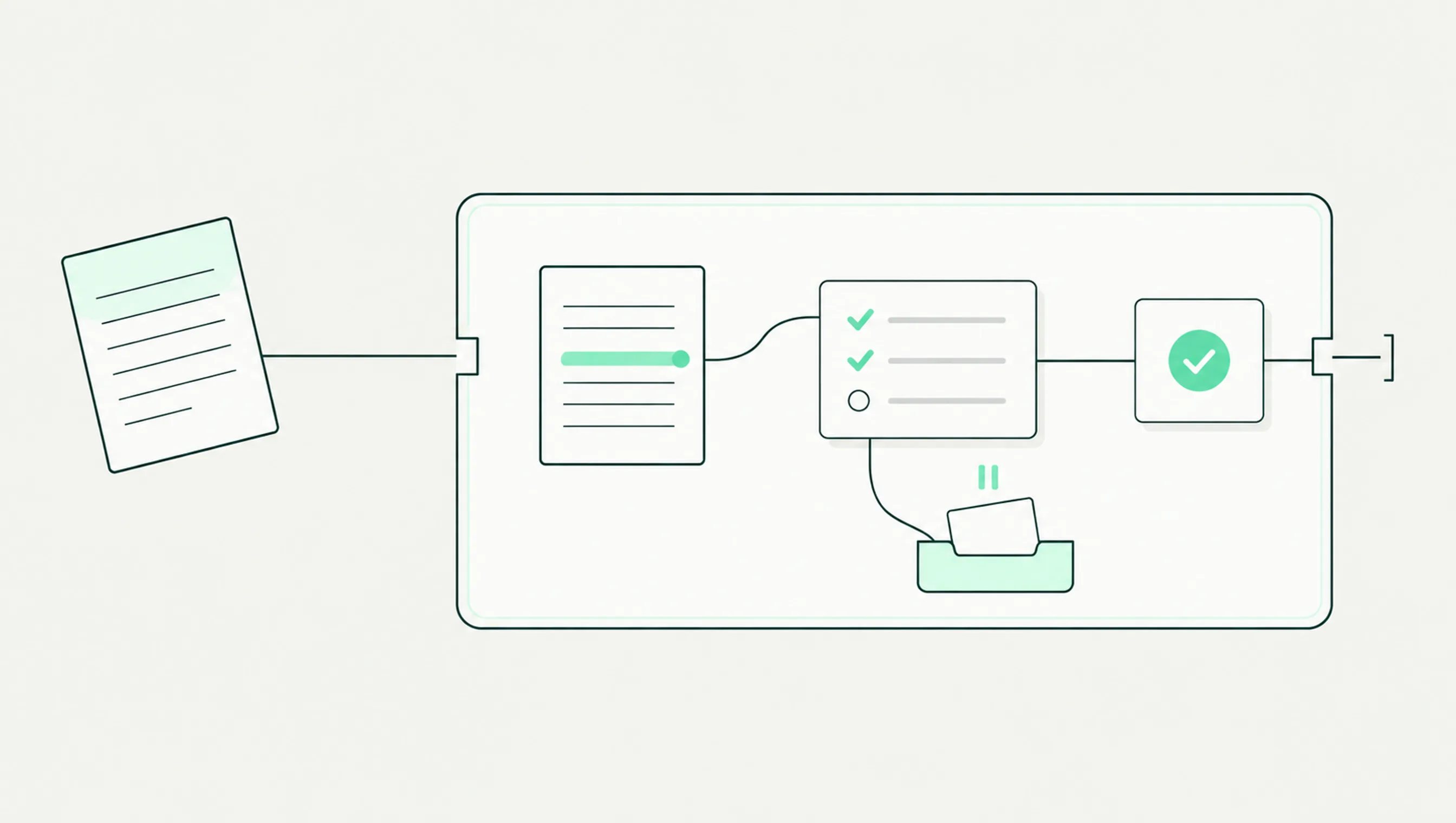
“Support customer onboarding” leaves too much undefined. “Check a submitted document pack for required items and prepare a missing-information request for review” describes a task with inputs, an output and a decision boundary.
Write the task definition in operational terms. Specify who initiates the work, which records may be used, what successful completion means and which actions remain outside scope. The definition should be understandable to the business owner as well as the delivery team.
For an initial document-checking agent, completion might mean a source-linked checklist ready for an employee. It should not imply that the customer has passed an eligibility assessment or that an account can be opened.
2. Separate Interpretation from Permission to Act
An agent may interpret documents and propose a next action. Whether it can execute that action should depend on controls outside the text it is reading.
Uploaded files, emails and web content are evidence, not instructions that can expand authority. A document that tells the agent to send information elsewhere should not override its configured task. Access and action permissions need to be enforced through the surrounding system.
Exhibit 1. A proposed permission model for document intake
| Capability | Initial permission and Boundary |
|---|---|
| Read an assigned application pack | Access to that case and approved reference material. No unrestricted search across unrelated customers. |
| Extract required information | Prepare values with source references. No silent replacement of confirmed customer records. |
| Identify missing items | Produce a draft completeness checklist. No eligibility or suitability decision. |
| Prepare correspondence | Draft a request for authorised review. No sending outside the configured contact process. |
| Update workflow status | Record verified events through approved actions. No closure based solely on an unverified model statement. |
Illustrative starting scope. Permissions should be established for the specific workflow and tested in the deployed system.
A prompt asking the agent to behave carefully is useful guidance. It cannot substitute for restrictions on the records it can access or the actions its tools permit.
3. Preserve State and Evidence Across the Workflow
Business processes unfold over time. A customer may upload a second document tomorrow, an employee may correct a field or another team may already have sent the missing-information request. The agent needs the current case state before it acts again.
Keep that state in a dependable business record. Distinguish work proposed, approved, attempted and confirmed as complete. If a connection fails after a request is sent, a retry must check what occurred before sending it again.
Evidence should travel with prepared outputs. A reviewer needs the source document, relevant passage and version used. If the source changes after approval, the process should determine whether that approval is still valid before continuing.
Shared logging can connect a task, the information used, the output prepared and the authorised action. The detail retained should support investigation while observing the firm's access and retention requirements. Logging itself also needs ownership and operating cost.
4. Test the Cases That Challenge the Design
A production decision should be based on representative examples, including ambiguous and incomplete work. A set containing only clean documents will not establish how the agent behaves when the workflow becomes difficult.
Include conflicting values, superseded documents, unexpected formats and content that attempts to redirect the agent. Test unavailable systems and delayed approvals as well as extraction quality. The question is whether the complete process responds appropriately.
For each test, define the acceptable outcome. An agent that stops and requests review may be performing correctly. A fluent answer that fills a gap with an unsupported assumption is not a successful completion.
Assess material errors separately from minor formatting issues. Average accuracy can hide the particular failure that matters most to a customer or the business. Maintain a set of regression cases so changes to prompts, tools or models can be checked against previously observed problems.
5. Make Recovery a Normal Operating Capability
An agent will sometimes be unable to complete its task. The firm needs a named team to receive the exception, enough context to continue manually and a reliable way to stop further automated activity on the case.
Design the handoff before launch. A useful exception record explains what was attempted, what succeeded, what remains unresolved and where the evidence can be found. “Agent failed” is insufficient for a service employee trying to help a customer.
Exhibit 2. Production exceptions and their intended response
| Event | Intended response |
|---|---|
| Two documents contain conflicting information | Hold the affected update and route the discrepancy for review. |
| A tool reports an uncertain outcome | Check the authoritative record before retrying. |
| The assigned approver is unavailable | Route to the defined backup or leave the action on hold. |
| The source changes after review | Reassess the prepared output and any approval tied to it. |
| Error rates rise after a release | Pause the affected capability and use the tested fallback. |
Proposed operational responses; implementation depends on the underlying systems and task.
Ownership should cover both business resolution and technical support. These responsibilities may sit in different teams, but the employee managing the case should know which route to use.
6. Establish the Production Business Case
Measure successful completion of the bounded task, including review, exceptions and recovery. Faster generation has limited commercial value if employees spend more time checking the result or resolving duplicate actions.
A pilot scorecard should include material error rates, turnaround, review effort, exception volume and total operating cost. Technical measures such as tool failures and response times help diagnose issues, but they do not replace service outcomes.
Start with a restricted rollout that the support team can manage. Where appropriate, run the agent in a mode that prepares outputs without executing live actions, then expand permissions only after the relevant behaviour has been demonstrated.
Production approval should also confirm ongoing ownership, monitoring thresholds and the conditions for pausing the service. The business is accepting an operating responsibility as well as a technology capability.
7. Reuse the Foundation and Reassess the Decisions
Access management, evidence links, evaluation tools and monitoring can support more than one agent. Reusing them can reduce duplication and make behaviour easier to oversee across the firm.
Decision rules still belong to each workflow. A capability approved to check document completeness is not automatically suitable for lending decisions, personal advice or payment instructions. New actions, data and users change the assessment.
Maintain an inventory of agents, their owners and their permitted tasks. Retest when the surrounding systems or instructions change, and retain a practical way to retire capabilities that no longer justify their cost.
The goal is an agent that the business can explain, support and improve. Production readiness is demonstrated through reliable work under real operating conditions.
Assess Your Agent’s Path to Production
Bring an existing AI pilot or a proposed operational task to a discovery conversation with SENNSE. We can examine the scope, integrations, review points and evidence needed for a controlled production rollout.

The Business Decisions That Should Come Before an AI Implementation
Financial Services & Artificial Intelligence · Aug 28, 2026
How AI Can Give Financial Advisers More Time for Clients
Financial Services & Artificial Intelligence · Aug 13, 2026

Beyond the Renewal Reminder
Insurance & Artificial Intelligence · Sep 14, 2026