
AI Agents for Marketing: 7 Uses That Drive Leads
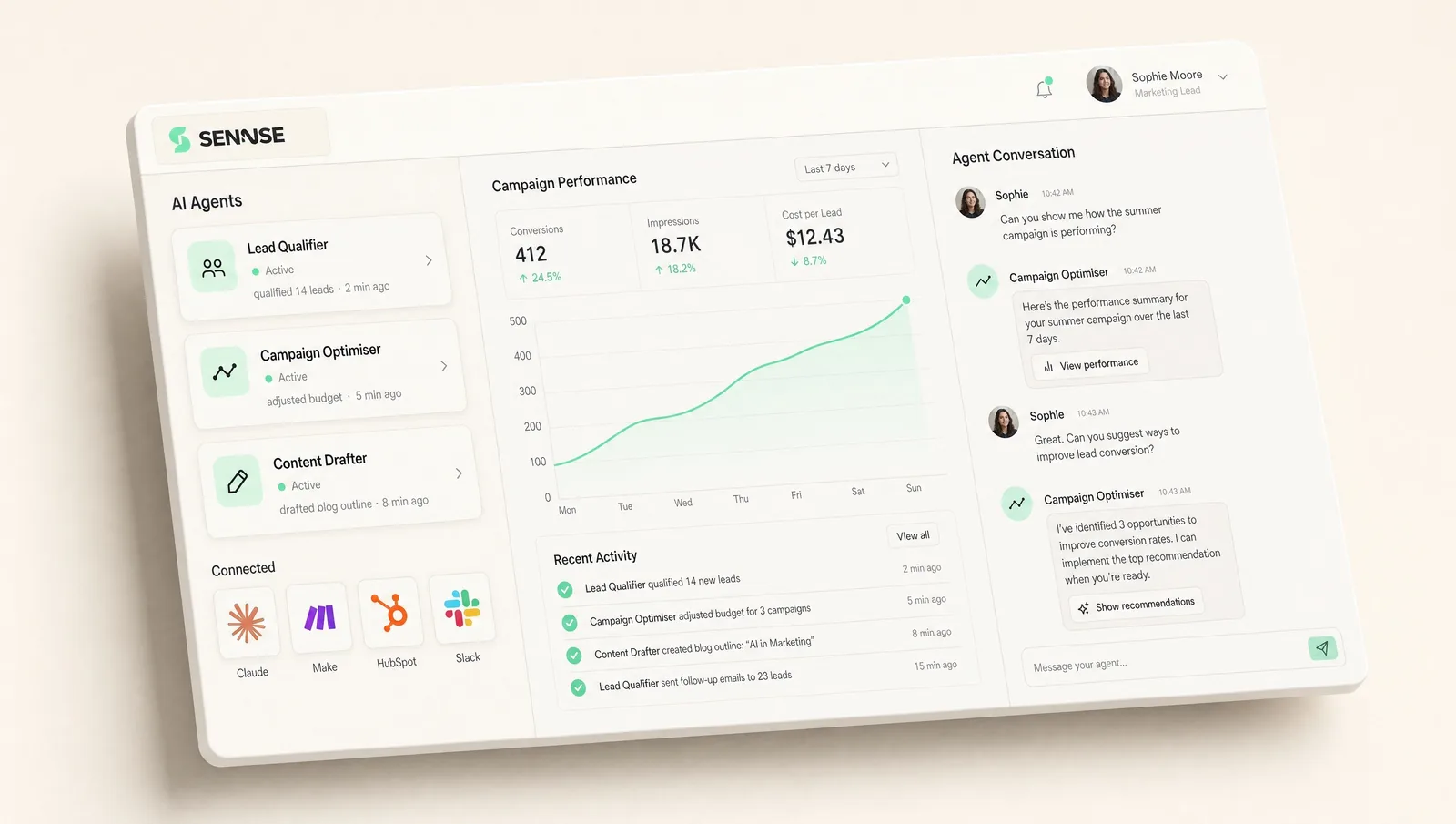
AI agents for marketing are software that take a marketing task, use the tools your business already runs (CRM, inbox, ad accounts, website) and complete it: qualifying enquiries, following up leads, drafting content and watching campaigns. A person still sets the rules, reviews the output and closes the sale.
Marketing agents: the team you didn't hire is already working
Most service businesses we speak with are still running marketing the way they ran it in 2020. A part-time marketer (or the founder, at 9pm). A CRM nobody updates. A website that captures leads and drops them into an inbox where they go to die.
Meanwhile, the businesses pulling ahead are quietly running AI agents that work 24/7. They qualify enquiries the moment they land, personalise outreach at scale, write and test ad copy, and route hot leads to the right person before a human has even seen the form submission.
This isn't ChatGPT with extra steps. AI agents are a different category of tool, and they're changing what's possible for businesses without a $20K/month marketing budget.
What an AI marketing agent is: 7 uses that drive leads
An AI agent is software that can take a goal, decide what steps to take, use tools (your CRM, your email platform, your calendar, your website) and complete tasks autonomously. Built on models like Claude, agents don't just answer questions. They do work.
For marketing, that work falls into several categories:
1. Lead qualification and routing. An agent reviews every inbound enquiry (form submission, email, chat), scores it against your ideal client profile, enriches it with public data, and routes hot leads straight to the right person with a pre-written response ready to send. What used to take 4 hours of admin per week happens in 30 seconds, per lead.
2. Outbound personalisation at scale. Instead of generic cold email blasts, an agent researches each prospect (their site, recent news, LinkedIn activity), drafts a genuinely personalised first message, and queues it for review. You go from 20 personalised messages a week to 200 without losing the personalisation.
3. Content production. Agents draft content targeting specific search terms, generate ad copy variations, write social posts from your existing case studies, and update meta descriptions across hundreds of pages. The human still reviews and signs off. The grind work is gone.
4. Campaign optimisation. Agents monitor your Google Ads and Meta campaigns continuously, pause underperforming keywords, reallocate budget and flag anomalies. They do at 2am what an agency analyst does on Wednesday afternoon.
5. Lead follow-up and nurture. Plenty of leads don't buy on the first reply. An agent watches every open enquiry, drafts the next follow-up when a lead goes quiet, matches it to what the person asked about and stops the sequence the moment they reply or book. For Metric Engineering we set up automated follow-up sequences for cold leads alongside enquiry routing. In Australia, marketing emails need consent, must identify you as the sender and must make it easy to unsubscribe under the Spam Act, so the agent works from your consented list only.
6. Ad creative and testing. An agent turns one brief into a set of headlines, hooks and image concepts for each audience, labels every variant, then reads the results each week and suggests which angles to retire and which to push. A designer or marketer still approves what goes live. We used AI-assisted creative testing on Elevate Kitchens' paid campaigns to find the angles that convert.
7. CRM updates and pipeline reporting. An agent logs every enquiry, call note and email reply against the right contact, moves deals between stages and sends a short pipeline summary each Monday: new leads, stalled deals, who needs a call. Nobody re-keys a form into a spreadsheet, so the report shows what actually happened that week.
An AI agent for sales and marketing: where the handoff sits
The same agent often spans both teams, because the gap between a marketing enquiry and a sales conversation is where leads tend to go cold. An AI agent for sales and marketing picks up the enquiry, qualifies it, updates the CRM, drafts the reply and books the call. Your salesperson takes it from there.
The line is simple. The agent gathers context and prepares the next step. A person decides on scope, price and fit. That person also runs the conversation that wins the work.
That's how we set up lead handling for Metric Engineering. Every new enquiry was categorised by service and assigned with a draft quote ready for review, inside a ClickUp pipeline that became the single source of truth for leads and live jobs. Together with a rebuilt brand and website, the new growth system tripled their leads within 90 days.
Where it goes wrong
Three failure modes we see repeatedly:
Bolt-on AI. A clinic adds a chatbot to their site, doesn't connect it to the CRM, and now has a fourth disconnected tool. Agents only pay back when they're connected to the systems running the business.
No human handoff. An agent that tries to close the sale itself loses trust fast. Agents qualify, draft and route. Humans close. Don't skip that line.
Letting the model run blind. Agents need guardrails. A well-built deployment has clear escalation rules, logged outputs, and a human reviewing the first batch of conversations before it goes fully autonomous.
AI agents for digital marketing: where to start
Don't build all seven at once. Pick the use where the most hours or the most leads leak today. For many of the service businesses we speak with, that's lead qualification or follow-up, because the enquiries already exist and the cost of a slow reply is easy to see.
Map the current process. Write down who touches an enquiry, in which tool and how long each step takes. If the process is unclear on paper, an agent will only run the confusion faster. Our AI playbook for service businesses shows how to spot the opportunities worth building.
Decide the rules before the build. Settle what counts as a qualified lead, who owns each handoff and what the agent must never send without approval. We cover the business decisions to make before an AI implementation in a separate piece.
Connect it and review the first batch. Give the agent access to the CRM, inbox and calendar it needs, nothing more. Read its first batch of drafts before it sends anything on its own.
Measure one number. Track the thing the use was meant to change: time to first reply, leads followed up or hours of admin per week. If it moves, add the next use.
That's how we build AI agents for marketing: one use at a time, connected to the systems you already run, with a person reviewing the output.
The window is closing
Two years ago, deploying an AI agent meant hiring a developer for three months. Today, with MCPs and orchestration platforms, a properly scoped agent goes live in 2 to 4 weeks. The businesses building this infrastructure now will spend the next 18 months compounding the advantage.
The competitors still hand-keying CRM updates and copy-pasting follow-up emails won't catch up. They'll just keep losing leads they never knew they had.
If your marketing still depends on someone remembering to follow up, that's the gap. AI agents close it. If you'd rather see the numbers first, book a discovery call and we'll baseline where your hours go.
Frequently asked questions
What is an AI marketing agent? Software that takes a marketing task like qualifying an enquiry or drafting a follow-up and completes it with your own tools. It works inside your CRM, inbox and ad accounts instead of a separate chat window. A person reviews what it produces.
Can one AI agent handle sales and marketing? It can cover the steps between them: qualifying the enquiry, updating the CRM, drafting the reply and booking the call. Closing stays with a person. Agents that try to sell on their own lose trust fast, so draw the line at the booked conversation.
Can I hire an AI agent to follow up leads? Yes. Lead follow-up is one of the simplest places to start, because the enquiries already exist and a missed follow-up is often a lost job. The agent drafts and sends follow-ups within rules you set, stops when the lead replies and hands warm leads to your team. Keep to your consented list and include an unsubscribe link in every marketing email.
Do AI agents for digital marketing replace a marketing team? No. They take the repeatable work off the team: triage, first drafts, reporting and routine campaign checks. Strategy, positioning, final approval and client relationships stay with people. For a small business, that often means the founder or one marketer can keep up with work that used to need more hands.
Book a discovery call
If you're not sure which of the seven uses would pay back first, book a discovery call. We'll look at how enquiries reach you today and the tools you already run, then tell you where an agent fits and where it doesn't.
Keep Reading
How to Connect Business Apps to AI Agents: Email, Calendar, CRM · A plain-English guide to connecting the software your small business already runs on (email, calendar, accounting, CRM) to an AI agent, and what it pays back.
What Is an AI Playbook? A Guide for Service Businesses · Most service businesses are wasting time on AI chatbots and content tools that don't move revenue.
Service Business Branding: How to Build a Standout Brand · Brand perception drives 23–33% revenue growth and decides whether buyers trust you before they ever speak to you.
Let's Get Started
Book a free discovery call. We'll map where AI pays off in your business and what to do first.